

Figure AI has signed a commercial agreement with Catalyst Brands — a Brookfield portfolio company operating over 1,800 retail locations under brands including JCPenney, Aéropostale, and Brooks Brothers. Figure 03 humanoid robots will be deployed at Catalyst's distribution center in Reno, Nevada, to support package sorting and packing. This is Figure's first commercial deal with a partner connected to a shared investor — and a real-world test of whether lab-grade autonomy holds up inside a live logistics hub.
Key takeaways
- Figure 03 will be deployed at Catalyst Brands' distribution center in Reno, Nevada
- Catalyst operates over 1,800 stores (JCPenney, Aéropostale, Brooks Brothers, Lucky Brand, Nautica)
- The deployment targets the Joey Pouch sorting system — part of a $40M infrastructure upgrade completed in 2024
- Catalyst is a Brookfield portfolio company — the same investor that backed Figure's Series C at a $39B valuation
- Neither party disclosed the number of robots or financial terms of the contract
After 200 Hours in the Lab — Time for a Real Warehouse
Figure AI spent the past week running a continuous livestream from its Sunnyvale facility. A fleet of Figure 03 robots sorted packages for 200 hours straight, logging zero hardware failures and demonstrating a wireless "hot-swap" charging protocol. The onboard Helix-02 model handled the full control stack. Impressive results — but a controlled environment is not the same as a live distribution center.
Catalyst Brands' Reno facility is a different level of complexity. Human workers are present. Package geometries are unpredictable. Lighting conditions shift throughout the day. The Joey Pouch sorting system — a computerized induction, sorting, and packing infrastructure — is the result of a $40M upgrade completed in 2024. Figure 03 will operate there not as a showpiece, but as a component in a live supply chain.
As we invest in and scale our portfolio, this collaboration with Figure shows how emerging technologies can modernize our operations while strengthening our workforce.
Marc Rosen, CEO of Catalyst Brands
The company positions humanoid robots as a tool to relieve workers of the most repetitive physical tasks — not to replace them outright.
Brookfield as the Connector
A shared investor is the structural backbone of this deal. Catalyst Brands is a Brookfield portfolio company. Brookfield participated in Figure AI's Series C funding round, pushing the startup's valuation to $39 billion. The two entities are connected beyond equity. Figure and Brookfield previously signed a data-collection agreement — Project Go-Big — giving Figure access to Brookfield's real estate to train its vision-language-action (VLA) models on recordings of everyday human activity.
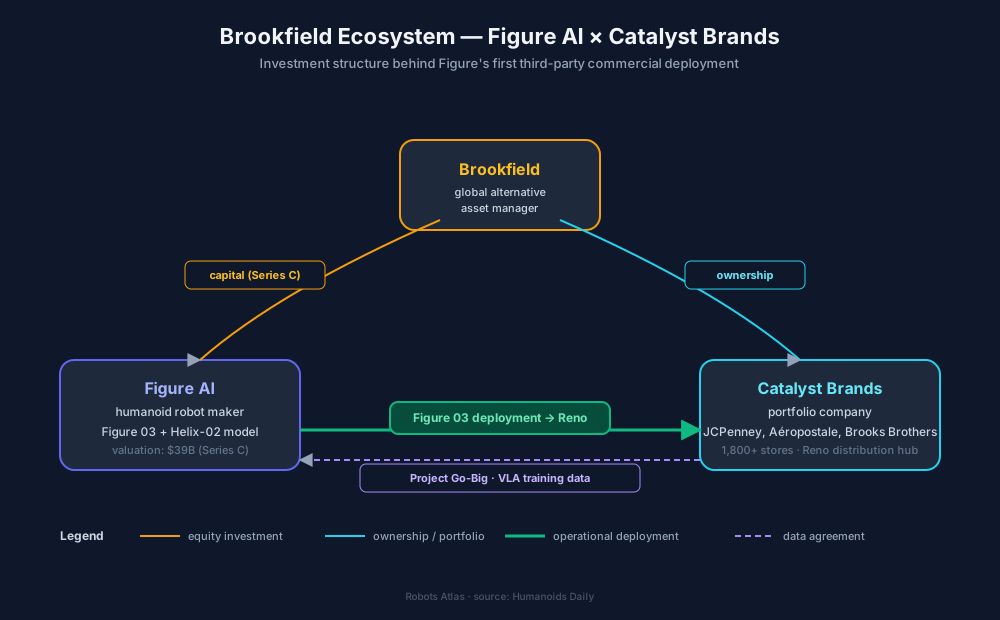
The Catalyst deal is the natural closing of that investment loop. Brookfield put capital into the technology. Now that same technology is being deployed inside an operational portfolio company — and it is expected to generate a return on that investment.
For Figure, this is more than a contract. It is the first commercial validation inside a third-party environment. BMW and earlier pilot deployments took place in partner manufacturing facilities. Reno is the first case where a Figure humanoid operates on behalf of an independent logistics customer.
What Figure Must Prove
The gap between lab and warehouse is fundamental. In Sunnyvale, Figure's team controlled every variable — package type, walking route, task schedule. In Reno, the robot will work alongside human employees in a real operational schedule.
Figure pitches the humanoid form factor as the only hardware capable of integrating into existing infrastructure without ground-up redesigns. That is a strong sales argument — but the real test is throughput. During a 10-hour sorting challenge, Figure 03 came close to matching a human worker's pace, but critics noted those were isolated trials, not production conditions.
Neither Figure nor Catalyst disclosed the number of robots or the deployment timeline. BotQ — Figure's in-house manufacturing facility — is currently scaling production capacity. The Catalyst contract is therefore both commercial proof-of-concept and a market signal: investors will be watching how many robots reach Reno and whether they remain there beyond a single quarter.
Why It Matters
Figure AI is not the first company to deploy humanoids in logistics — but it is the first with a $39 billion valuation doing so with a partner that runs over 1,800 stores and has a real operational budget. This is not a pilot project run on a handshake. It is a deal embedded in Brookfield's investment ecosystem, where there is a financial incentive for it to succeed.
For the broader humanoid industry, this sets a precedent. Until now, commercialization of bipedal robots rested primarily on demonstrations and research contracts. Deploying inside the operator of 1,800 retail locations is a qualitatively different category. If Figure 03 holds up in Reno for six months and delivers measurable throughput gains, the case for the next logistics customer becomes immediately stronger. If it fails — it will signal that the gap between demo and deployment is still too wide to cross.
What's Next
- Figure has announced BotQ capacity expansion — the number of robots shipped to Reno will be a real-world measure of production readiness
- Catalyst Brands has not disclosed a timeline, but the Joey Pouch project is operationally active — this is a planned integration, not a hypothetical future phase
- Brookfield holds an active real estate and logistics portfolio — success in Reno could open additional sites without separate contract negotiations


